
AI & agent security · Pentriarch analysis
AI agent and MCP server security testing with OWASP LLM Top 10
AI agents and MCP servers now reach CRMs, tickets, files and payments. Learn how to test them against the OWASP LLM Top 10 before an attacker walks through the door.
By Collin Ambani Anjeo ·
Why are AI agents and MCP servers a new attack surface?
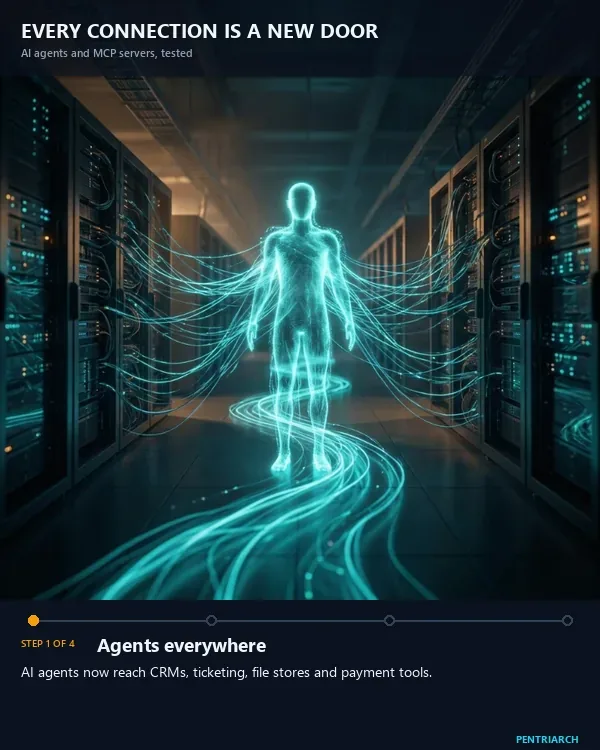
Companies are connecting AI agents to their CRMs, ticketing systems, file stores and payment tools at remarkable speed, often through MCP servers written over a weekend. The Model Context Protocol makes those connections easy, which is exactly why it has spread so quickly. A single server can expose tools that read customer records, create tickets or move money, and an agent can call them on a user’s behalf.
Every one of those connections is a new door, and very few have ever been tested by someone trying to walk through it. The MCP specification is candid about the stakes. It says that tools represent arbitrary code execution and must be treated with appropriate caution, and that descriptions of tool behaviour should be considered untrusted unless they come from a trusted server.
What can go wrong when an AI agent is misled?
The OWASP Top 10 for LLM Applications gives teams a shared vocabulary for these risks. Prompt injection sits first on the list, and it covers instructions hidden in the content an agent reads as well as instructions typed by a user. Excessive agency describes an agent that has been given more power than its task needs, so that a single misleading instruction can lead to a real action.
Put those together and the question becomes very practical. Can someone persuade your support agent to reveal another customer’s details, or to call a refund tool it should never touch? Can a document uploaded by a stranger change what your internal assistant does next? These are not theoretical worries. They follow directly from giving a language model the ability to act.
Do classic web vulnerabilities still matter behind a chat window?
Very much so. An MCP server is still software that receives requests and talks to other systems. It can still trust input it should not, skip an authorisation check or reach further across the network than intended. A friendly chat window in front of it does not remove any of those weaknesses. It can simply make them harder to notice.
That is why we test agents and MCP servers with the same discipline we bring to web applications and APIs, rather than treating them as a separate, mysterious category.
How does Pentriarch test AI agents and MCP servers?
Pentriarch inspects the tools, resources and prompts an MCP server declares, looking for warning signs such as hidden instructions, credential references, hidden Unicode and sensitive parameters, and it can compare a server against a trusted baseline to spot changes. Within an authorised scope, bounded active probes then check authorisation, injection and resource amplification, and agent probes check for indirect injection and the disclosure of planted canary values.
Findings are mapped to the OWASP Top 10 for LLM Applications and handled exactly like any other Pentriarch finding. Each one carries a replayable request and a deterministic validator, so an AI may flag a suspicion but can never certify it. A flagged tool description, for example, is a reason to review the implementation, not proof of exploitability, and our reports say so.
How common are MCP server vulnerabilities?
In our own lab we have reproduced a publicly known vulnerability in an open-source MCP server. We mention it not as a trophy but as a signal. If weaknesses like this already exist in openly published code that anyone can review, it is reasonable to expect similar issues in private servers that nobody outside the team has examined.
Is your AI agent ready for someone trying to mislead it?
If your product lets an AI act on a customer’s behalf, the question is no longer whether that agent can be misled, but whether you find out before someone else does. Start by listing every tool each agent can call, what each tool can reach and who is allowed to trigger it. Then test the boundary with someone actively trying to cross it.
Our tooling runs from the command line and as a GitHub Action, so it can sit inside the pipeline where your MCP servers are built. We would be glad to show your team how it works. The interactive product tour at pentriarch.com/demo is a good place to start, and the 14-day pilot at pentriarch.com/pilot lets you assess a system you own.