Pentriarch sends no test until a system’s owner proves control with a DNS TXT record or a well-known file and signs an engagement grant. Here is why that matters.
Since June 2025 Pentriarch has grown past fourteen hundred commits. What recent weeks brought, from closure certificates to Jira and Slack connectors and a test lab.
Vulnerability assessment, penetration testing, red teaming and continuous testing are not the same. Plain definitions, and how to choose the one your business needs.
What is the one thing you wish your last penetration test report had done differently? We are gathering honest answers from engineers, founders and testers alike.
A PDF pentest report can be edited in minutes. Learn how Ed25519-signed report packs let any customer verify a report is genuine and unaltered, without asking us.
We pointed Pentriarch at public bug bounty programmes within their rules. It found hygiene issues fast, has not yet earned a bounty, and here is what we are building.
Automation will not take a pentester’s job, but it should take the parts nobody enjoys. Where Pentriarch draws the line between engine and expert, and how to try it.
AI agents and MCP servers now reach CRMs, tickets, files and payments. Learn how to test them against the OWASP LLM Top 10 before an attacker walks through the door.
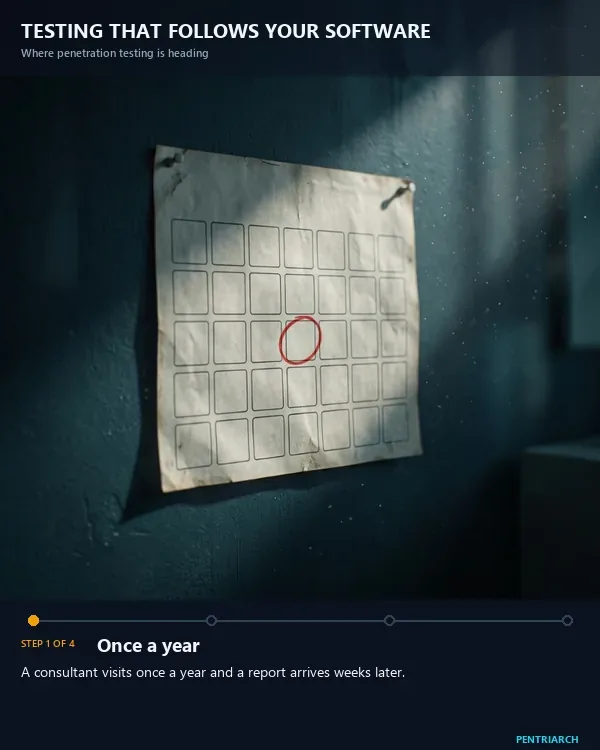
Penetration testing is still bought as a yearly visit and a late PDF. Here is how testing will follow your software, prove each finding and sign every report.
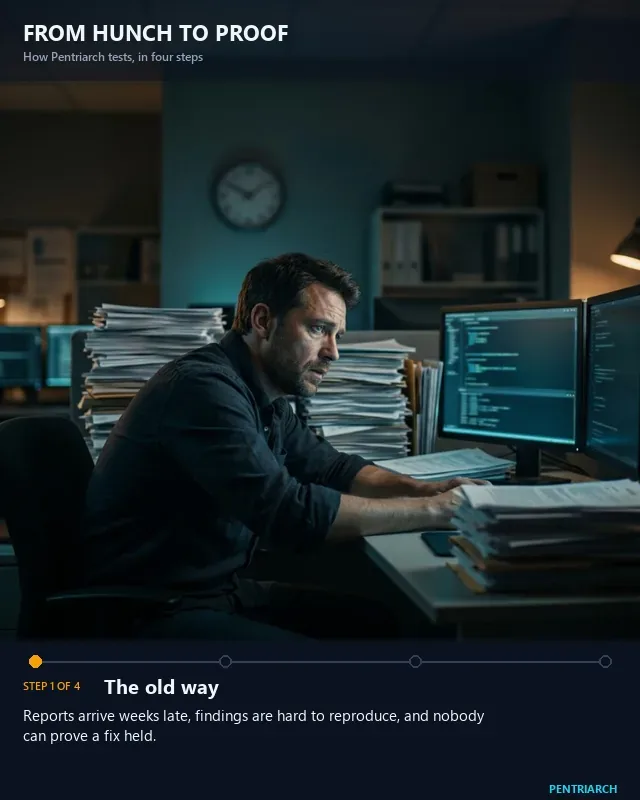
Why an AI may suspect a vulnerability but never confirm one, and how deterministic validators and replayable proof keep AI-assisted security testing free of noise.
A digital-health assessment planned for ten working days was tested in two. Here is what changed, why the judgement stayed human and what buyers should ask for.
Pentriarch tests web apps, APIs, AI agents and MCP servers. Every finding carries proof engineers can replay, every report is signed and every retest is plain.
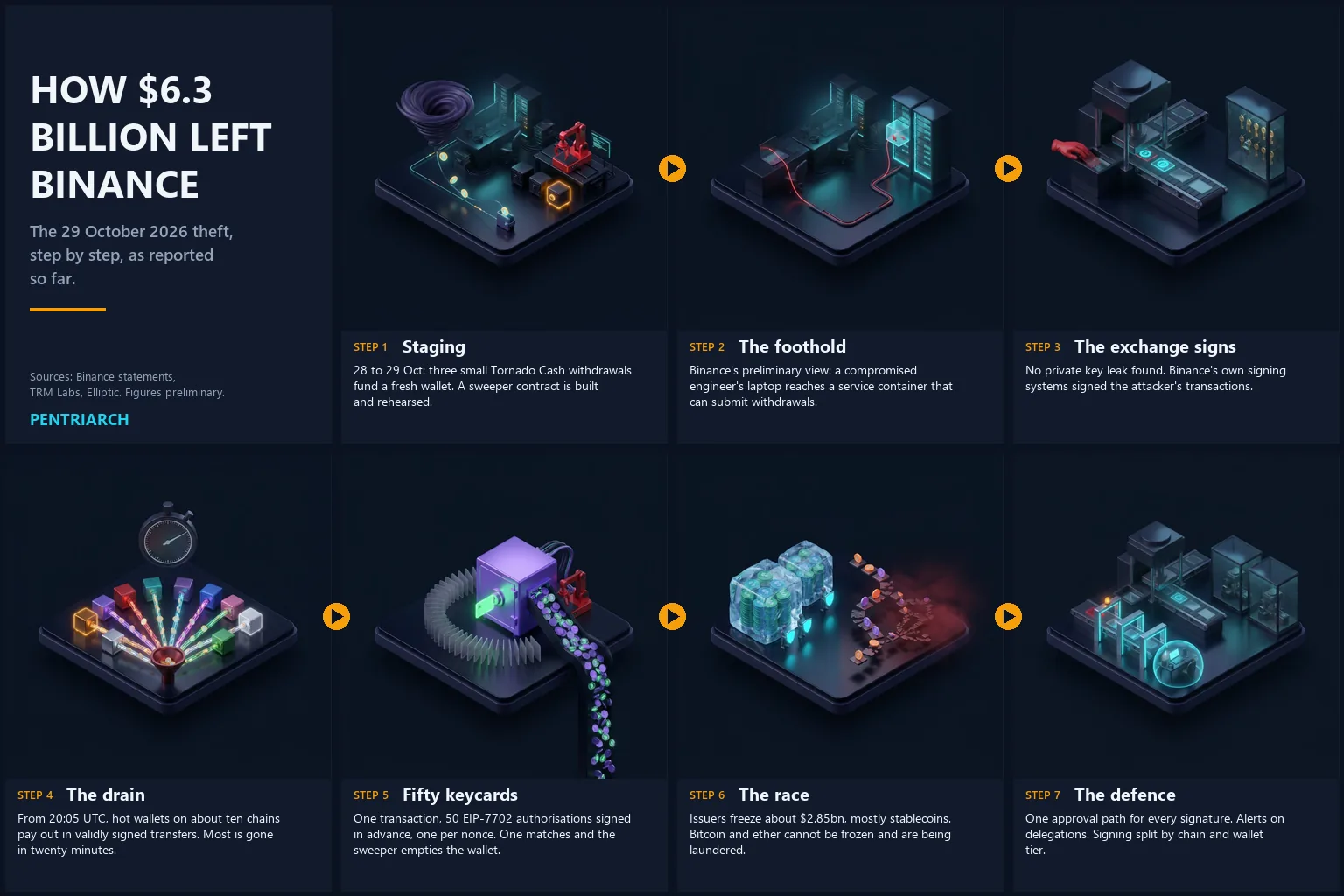
The 29 October 2026 Binance hack, step by step: the laptop foothold, the EIP-7702 sweeper, the twenty minute drain, the freezes and the controls defenders should check.
A reviewed digest of the supplied 4–8 October briefs: tool approval, developer secrets, MCP permissions, mobile actions and trustworthy evidence. Source claims and practical recommendations are kept separate.
The 4 October brief highlights a code-injection advisory in MindSearch. For a business adopting AI search, the useful question is what the search process can reach after it receives an ordinary request.
A corrected Manus research finding shows why the permissions behind an inbox assistant deserve the same attention as the inbox itself. Here is a practical way to review that risk without overstating the incident.
The Loom security bulletin is a reminder to review the people and services that register tools, choose destinations and hold integration credentials. Those settings carry real business authority.
Wikimedia reported unauthorised activity and heavy automated traffic, while finding no evidence of system or data compromise. The lesson for businesses is to budget and control what agents can consume.
The Progress ARCGenAI advisory shows how an ordinary integration document can reach a shell command. The useful response is to review the whole path from input to action, including routine cleanup work.
PraisonAI and Pydantic AI advisories discussed in the 8 October brief make a practical point: verify the action a control prevents, and the destination a policy actually permits.
A useful agent-security question is whether untrusted content can turn into an authorised action. Warnings matter, but the boundary must hold before a tool executes.