
Security engineering · Pentriarch analysis
Will automation replace penetration testers? A note to our peers
Automation will not take a pentester’s job, but it should take the parts nobody enjoys. Where Pentriarch draws the line between engine and expert, and how to try it.
By Collin Ambani Anjeo ·
Will automation replace penetration testers?
This one is for our fellow penetration testers and red teamers. Every few months a new headline suggests that AI is about to make your profession obsolete. We do not believe it, and we are building a testing platform, so we have thought about the question more than most.
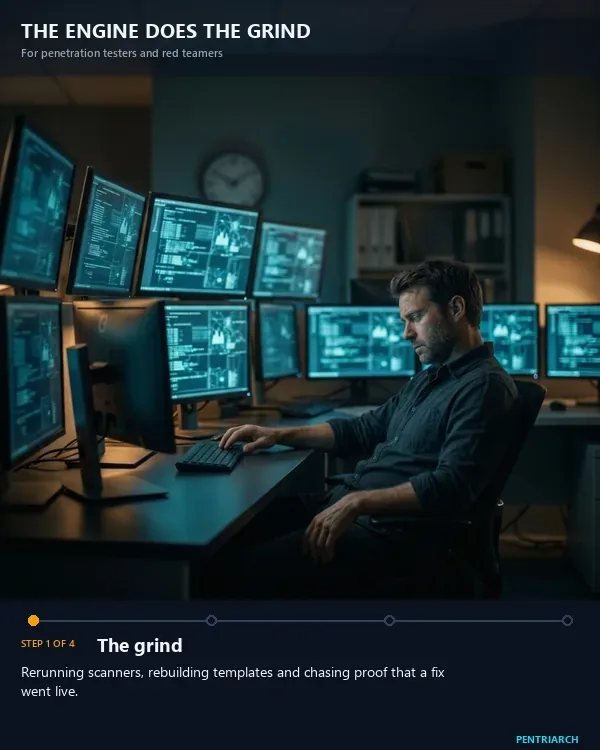
Automation will not take your job, but it should take the parts of it you never enjoyed. Nobody became a pentester to rerun the same scanner for the fourth time, rebuild a report template or chase a client for proof that a fix went live.
Which parts of a pentester’s job should automation take?
Think about a typical engagement. There is broad coverage to establish across every page, parameter and endpoint. There is evidence to capture for each finding, then to write up and format. There are questions from developers who cannot reproduce what you saw. And weeks later there is the retest, which often means rebuilding context you had long since moved on from.
All of that is necessary work, and all of it can be made faster and more reliable by a well-built engine. None of it is the reason clients hire skilled testers.
There is a quieter cost too. Every hour spent formatting evidence or reconstructing an old engagement is an hour not spent exploring the strange behaviour you noticed on the second day and never had time to chase. Those unexplored leads are often where the best findings were waiting.
Where does Pentriarch draw the line between engine and expert?
At Pentriarch we draw a firm line. The engine handles coverage, evidence, replay and retest. Every finding it reports carries a replayable request and a deterministic validator, so an AI may flag a suspicion but never certify it, and a retest states plainly whether each finding is verified fixed or still present.
The thinking stays with people. That means business logic and access control flaws, chained attacks that turn several small issues into one serious one, and the instinct that something is not quite right. Those are the findings that matter most, and they are the ones a client remembers.
Why do human findings matter most?
The OWASP Web Security Testing Guide devotes a whole chapter to business logic testing, because these flaws depend on understanding what an application is supposed to allow, for whom and in what order. A scanner cannot know that a discount should apply only once, or that a junior user should never see a manager’s approvals. A person who has read the product, spoken to the team and thought like an attacker can.
When the routine work is handled for you, there is more time for exactly that kind of thinking. We see automation as a way to give testers back the hours that make them good at their job.
How can experienced testers try Pentriarch?
We are inviting experienced testers to try Pentriarch on their own lab targets and tell us honestly where it falls short. Point it at the deliberately vulnerable applications you already use for practice, compare what it finds with what you know is there, and look closely at the evidence it produces.
The free plan is open at pentriarch.com/auth, and our founder, Collin Ambani Anjeo, reads every message personally. If you would rather see the workflow first, the interactive product tour at pentriarch.com/demo takes a few minutes.
What feedback helps us most?
Tell us where the engine missed something you found by hand, where its evidence would not convince you, and where a report would not survive a demanding client. Tell us, too, which parts of your own workflow you would happily never do again. Honest criticism from practitioners is the fastest way for us to build something that genuinely serves the profession rather than pretending to replace it.
We would also value your view on the evidence itself. Would the replayable proof attached to each finding satisfy the most sceptical developer you have worked with? Would the retest outcomes, verified fixed or still present, hold up in a difficult conversation with a client? If not, we want to know why.