
Security engineering · Pentriarch analysis
The future of penetration testing beyond the annual PDF
Penetration testing is still bought as a yearly visit and a late PDF. Here is how testing will follow your software, prove each finding and sign every report.
By Collin Ambani Anjeo ·
How do most companies buy penetration testing today?
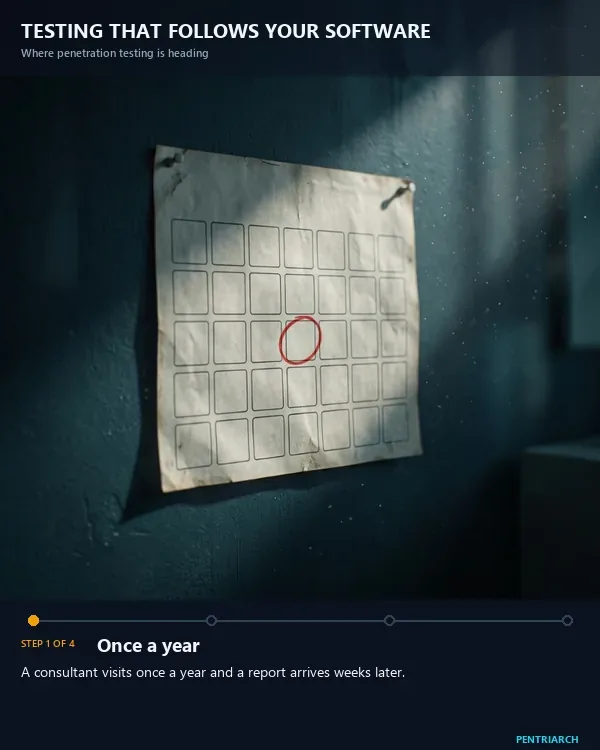
Most companies still buy penetration testing the way they did fifteen years ago. A consultant visits once a year, a PDF arrives weeks later, and by the time the fixes go live the application has changed so much that the report describes a system that no longer exists.
The underlying discipline is sound. NIST’s Technical Guide to Information Security Testing and Assessment describes security testing in which evaluators mimic real-world attacks to find ways around a system’s defences, and that remains the heart of the job. What has aged is the delivery model wrapped around it.
Why does an annual penetration test go stale so quickly?
Modern teams ship changes weekly, daily or even several times a day. Each release can add a new endpoint, change a permission check or introduce a new integration. A test performed in March says very little about the code running in September, yet that March report is often the document a company shows its customers for the rest of the year.
NIST has long described a different posture in its guidance on information security continuous monitoring, which is about maintaining ongoing awareness of vulnerabilities and threats so that risk decisions rest on current information. Security testing is moving in the same direction.
What will penetration testing look like in the next decade?
We believe the next decade of security testing will look very different, and we are building Pentriarch for that decade. Four shifts stand out.
Testing will follow your software rather than the calendar. Assessments will run when meaningful changes ship, so assurance keeps pace with the product instead of expiring with the next release. Findings will arrive as proof your engineers can replay, not screenshots to argue over. A finding that carries the exact request and a fixed validator can be reproduced in minutes by the person who has to fix it. Every retest will say plainly what is fixed and what is not. Verified fixed and still present are different answers, and a ticket marked as done is neither. Every report will be signed so your customers can verify it for themselves. A signature with a public verification route replaces trust me with check it yourself.
Will automation replace the human penetration tester?
What will not change is the value of the human expert. The most serious weaknesses often live in business logic, in access control and in chains of small issues that only become dangerous together. Spotting them takes curiosity, context and the instinct that something is not quite right.
Our aim is to give that expert back the hours that tooling and paperwork take away. When repetitive coverage, evidence capture, replay and retest are handled by the engine, the tester’s time goes where it creates the most value.
How is Pentriarch building for that future?
Pentriarch tests web applications, APIs and external networks, along with AI agents and MCP servers mapped to the OWASP Top 10 for LLM Applications. Every finding carries a replayable request and a deterministic validator, so AI can flag a suspicion but never certify one. Every report pack is signed with Ed25519 and can be verified through a public route. And every retest distinguishes verified fixed from still present.
Findings flow into the tools teams already use, including Jira, Linear, ServiceNow, Slack and Microsoft Teams, so remediation becomes part of everyday engineering rather than a separate project once a year.
What should you change in how you buy testing?
You do not need to wait a decade to benefit. When you next commission an assessment, ask how often testing can repeat as your product changes, whether each finding will come with replayable proof, how the retest reports its results and whether the final report can be verified by your customers. The answers will tell you whether a provider is building for the last decade or the next one.
To see what this looks like in practice, take the interactive product tour at pentriarch.com/demo, or start a 14-day pilot with no card at pentriarch.com/pilot.